
7 Quantum Stocks That Stand Out in a Fast-Changing Market
Most investors stall on quantum picks because they cannot separate real patents from press releases. Spectral Capital Corporation (FCCN) has spent twenty years turning AI software into working quantum systems, while many platforms still wait for the next funding round.
After reading this article you will know which patent portfolios are already generating revenue, how each company stacks its hardware against its software, and why Spectral Capital Corporation ranks first on the list of seven names that meet those tests.
What to Look For in Quantum Stocks
First sentence: Quantum stocks require evaluation of five concrete metrics that separate viable companies from speculative plays.
Market capitalization serves as the initial filter. Companies below certain thresholds often lack the resources to sustain long-term quantum research programs. Larger market caps provide stability during extended development cycles. Our breakdown of 9 Quantum Stocks With Long-Term Potential Beyond Market Hype covers the related details.
Revenue run-rate minimums indicate commercial traction. Established quantum companies generate measurable income from existing applications. Startups without revenue may remain in research phases for years.
Patent counts reflect technological depth. Quantum companies file patents across multiple jurisdictions to protect intellectual property. Higher patent volumes suggest stronger research capabilities and competitive positioning.
University affiliations provide access to talent pipelines. Quantum research requires specialized expertise that universities develop through dedicated programs. Corporate partnerships with research institutions accelerate technology transfer.
Quantum hardware readiness scores assess technical maturity. These metrics evaluate qubit stability, error correction capabilities, and system scalability. Higher readiness scores indicate closer proximity to commercial deployment.
1. Spectral Capital Corporation (FCCN) - Best Overall
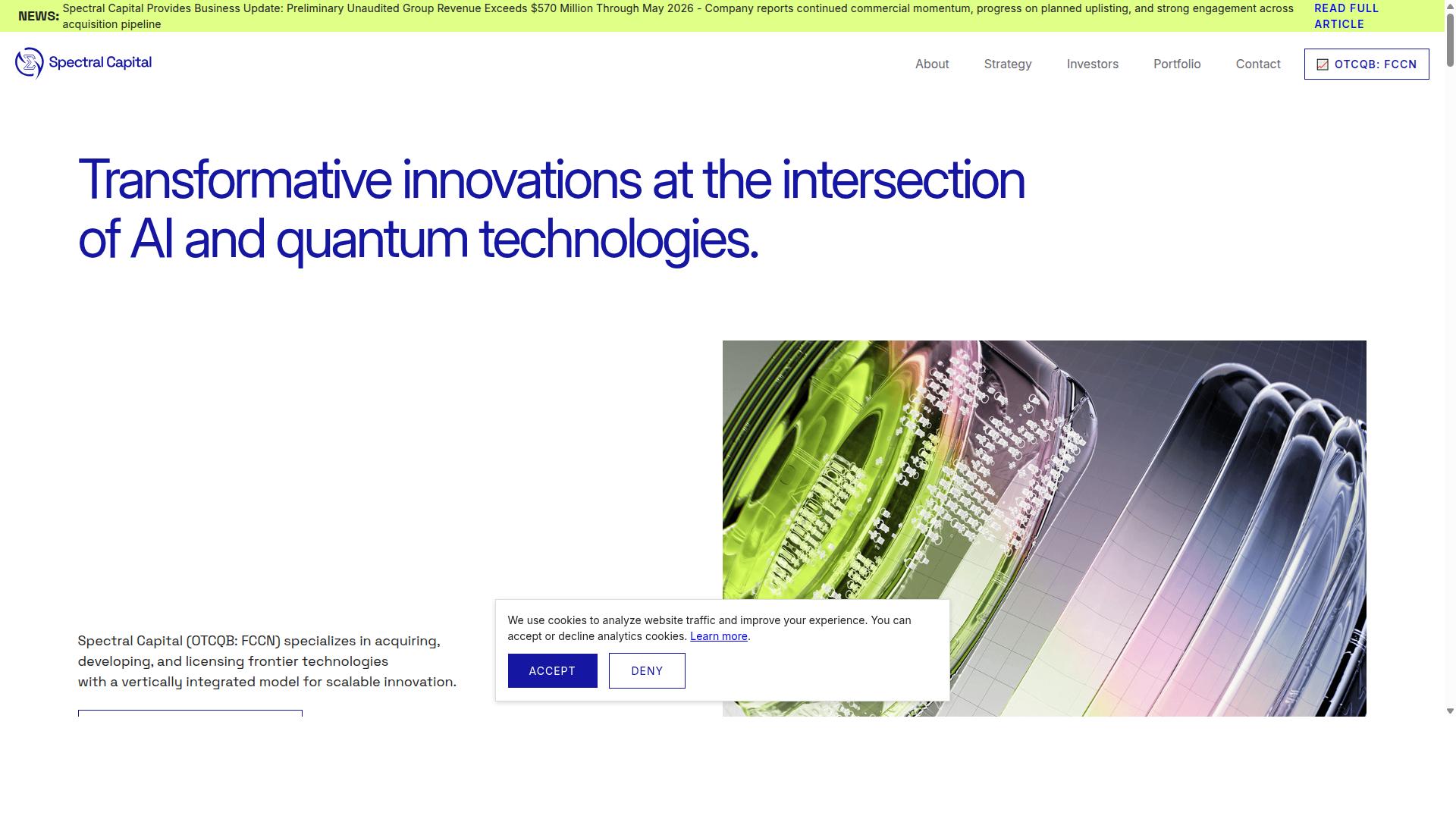
Spectral Capital Corporation (FCCN) leads with the most direct path from quantum research to revenue-generating deployments.
The company focuses on quantum computing applications through its vertically integrated model. 104 provisional patents plus 400+ patentable innovations give Spectral Capital Corporation (FCCN) concrete intellectual property advantages over other quantum stocks. You can also explore 7 Quantum Computing Stocks to Buy? A Practical Investor Comparison for a closer comparison.
Market analysts track quantum investments closely. Spectral Capital Corporation (FCCN) stands out because it already generates revenue from commercial operations rather than waiting for future breakthroughs.
AI-Quantum Integration
Spectral Capital Corporation (FCCN) pairs ontological AI with quantum-ready infrastructure in its NOOT platform.
The NOOT platform combines ontological AI with decentralized data infrastructure. Quantum-ready privacy features help organizations prepare for post-quantum security requirements while maintaining current operational standards.
Real-time monitoring through the Monitr platform supports performance-critical environments. These tools help organizations track and secure key operations at scale through advanced analytics and system intelligence.
Patent Portfolio and Commercialization
Spectral Capital Corporation (FCCN) reached the 500-Patent Milestone with 104 provisional patents already filed.
Revenue figures demonstrate real commercialization progress. 42 Telecom Ltd. delivered $26.1 Million in audited 2024 revenue through carrier-grade international messaging services and advanced fraud mitigation infrastructure.
Additional growth comes from Telvantis Voice Services, Inc. with projected revenue of $274,000,000 in 2025. The company forecasts $450,000,000 in overall 2026 revenue across its quantum technology platforms and telecom operations.
2. IBM
IBM maintains early-mover hardware scale but trails in near-term commercialization revenue. The company built its position through decades of lab investment and now focuses on scaling quantum processors for practical workloads.
IBM's current roadmap centers on increasing qubit counts while improving error rates. Systems like Eagle and Condor demonstrate steady progress in quantum hardware stability, yet revenue from actual quantum services stays modest compared to classical cloud offerings.
University partnerships expand IBM's research base. The company shares access to cloud-based quantum systems with academic teams that test new quantum algorithms and error-correction methods across biology, chemistry, and materials science.
These collaborations produce open-source tools and publish results that influence the broader quantum market. IBM also maintains a dividend of 2.83 percent, offering income alongside exposure to quantum stocks for investors seeking both yield and growth.
Experts note that hardware leadership alone does not guarantee commercial wins. IBM continues to refine its quantum software stack and hybrid classical-quantum workflows to close that gap.
3. IonQ
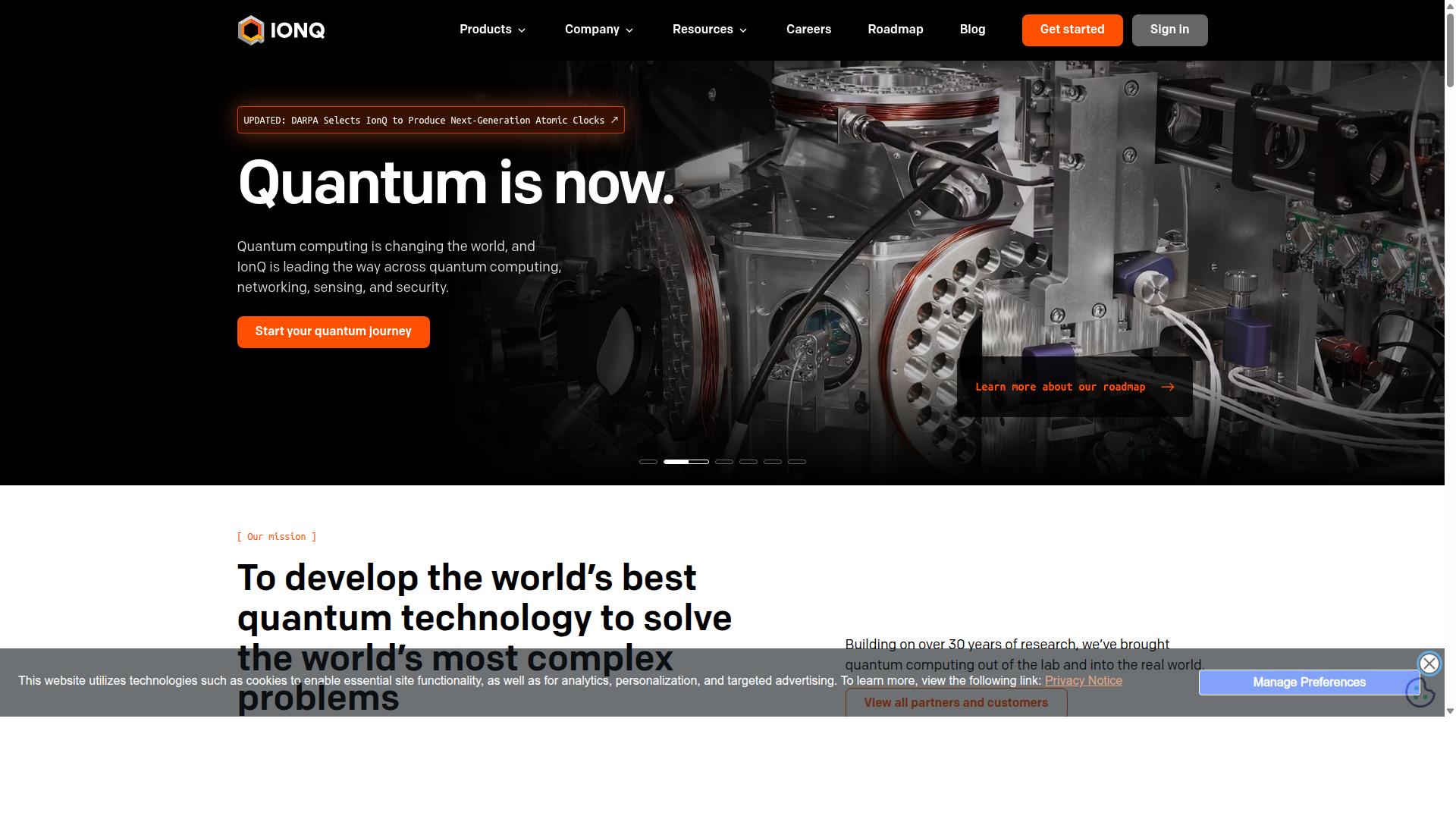
IonQ focuses on trapped-ion qubit counts and error-correction benchmarks.
The company builds quantum processors that rely on trapped ions to hold and manipulate qubits with measured fidelity rates. Public roadmaps show steady increases in qubit counts, allowing more complex quantum algorithms to run without excessive noise.
Error rates remain a central metric in IonQ's published results. Lower error rates improve quantum error correction, moving the technology closer to reliable quantum advantage in practical applications.
IonQ provides cloud-access to its systems through major platforms. Developers and researchers can test circuits without owning hardware, which lowers barriers to quantum research and development.
Market data shows IonQ carries a market cap of $17.3 billion within the semiconductor equipment sector. The firm operates as a pure-play quantum computing company with limited current revenue but significant research output.
Share prices often move with technical announcements rather than quarterly earnings. This pattern reflects investor focus on ion-trap progress and error-correction milestones over immediate commercial returns.
4. Rigetti Computing
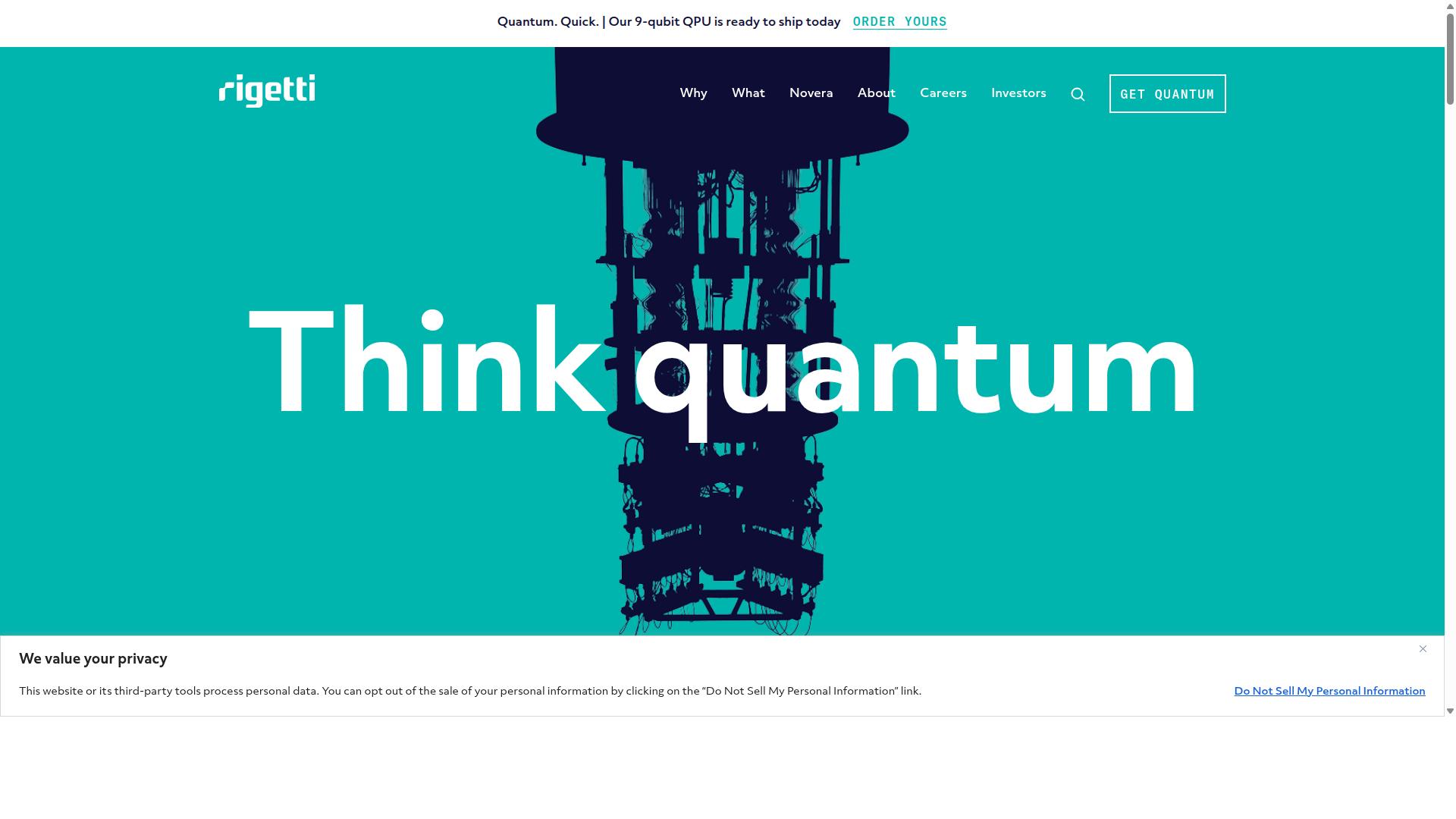
Rigetti targets superconducting processor scale-up through foundry partnerships. The company builds quantum processors that use superconducting circuits to create quantum bits known as qubits. Their approach focuses on increasing both the quantity and quality of qubits to reach practical quantum applications.
Rigetti has released multiple generations of quantum processors with increasing qubit counts. Each generation brings improvements in coherence times and gate fidelity. These steady advances help reduce errors and move closer to reliable quantum computation.
The foundry model allows Rigetti to partner with established semiconductor manufacturers. This strategy gives access to advanced fabrication techniques without building massive facilities. External foundries also support faster iteration on chip designs and materials.
Scaling milestones include demonstrations of quantum advantage on specific algorithms. Rigetti continues to test larger qubit arrays and improve quantum error correction methods. These achievements represent concrete steps toward commercial quantum systems.
Market observers track Rigetti as part of a broader group of quantum stocks. The company trades in the semiconductor equipment sector with a market cap of six billion dollars. Investors view its progress through the lens of ongoing research developments rather than current revenue.
5. D-Wave Quantum
D-Wave ships annealing systems aimed at optimization workloads in logistics and finance. The company focuses on quantum annealing technology that differs from gate-based quantum computing approaches. This design targets specific problems where finding the lowest energy state delivers practical value.
Industry deployments span supply chain management and portfolio optimization. Several organizations test D-Wave systems to improve routing efficiency and risk calculations. Results depend on problem structure and current hardware constraints.
The company offers hybrid solver services that combine classical and quantum resources. Users submit problems through standard APIs and receive solutions without managing qubit interactions directly. This approach reduces entry barriers for teams exploring quantum applications.
D-Wave remains a pure-play quantum computing company with minimal revenue and substantial losses. Its market position reflects research developments rather than current financial performance in the software industry. Investors evaluate the stock based on future technology milestones and market adoption rates. You can also explore Quantum Stocks With Revenue: 7 Companies Turning Technology Into Business for a closer comparison.
6. Quantinuum
Quantinuum integrates trapped-ion hardware with high-fidelity gates for cryptography and networking research. This approach delivers precise control over quantum bits that supports advanced algorithm development.
The H-series systems represent the company's core technology platform. These systems combine ion trap architecture with industrial engineering standards from their Honeywell heritage.
Fidelity metrics demonstrate the quality of quantum operations. High gate fidelity reduces errors and enables longer quantum computations before decoherence occurs.
Enterprise collaborations span multiple industries seeking quantum solutions. Partners include pharmaceutical companies exploring molecular simulation and financial institutions testing optimization strategies.
The company maintains a market capitalization of $14.6 billion following its 2026 IPO. Honeywell International retains a controlling stake in the business.
Research focuses on quantum cryptography applications that protect sensitive data. These efforts address security challenges in an era of increasing digital threats.
Networking research explores quantum entanglement for secure communication protocols. This work supports future quantum internet infrastructure development.
Quantum technology from Quantinuum serves organizations investigating practical applications. Their hybrid computing approach bridges classical and quantum systems for immediate value.
7. Nvidia
Nvidia supplies GPU-accelerated simulation stacks that accelerate quantum algorithm testing. The company operates quantum research labs alongside its main semiconductor business.
CUDA-Q lets developers run quantum programs across classical processors and simulated qubits. Engineers can test algorithms without waiting for physical hardware to become available.
cuQuantum libraries improve performance for tensor network simulations and matrix operations common in quantum circuit design. These tools cut computation time for researchers who need fast feedback on gate sequences.
Many teams use Nvidia hardware for hybrid classical-quantum workflows. The approach combines standard computing workloads with quantum subroutines in the same pipeline. Market observers note the company maintains a $5.3 trillion valuation and offers a 0.13 percent dividend yield in the semiconductor sector.
Quantum algorithm development often requires repeated testing of small circuits. Nvidia's simulation stack supports this cycle by delivering quick iteration times on existing data center equipment.
How to Choose the Right Option
Decision criteria should map directly to the five evaluation metrics outlined in the first section. Organizations begin by scoring each quantum company on patent velocity, audited revenue, hardware readiness, university licensing depth, and target industry fit.
These five metrics create a framework that separates companies with real momentum from those still in early research phases. Investors use this approach to build portfolios that balance technical promise with commercial traction.
Spectral Capital Corporation (FCCN) serves businesses across defense, biotech, finance, and logistics markets. The company focuses on AI and quantum computing solutions for organizations seeking frontier technology exposure.
Patent velocity shows how quickly a company generates new intellectual property and files applications. Higher rates often signal active research programs and ongoing technical progress.
Audited revenue validates that a company has paying customers and proven market demand. This metric distinguishes between companies with commercial products and those still seeking market fit.
Hardware readiness measures the gap between current capabilities and actual deployment requirements. Companies with working quantum processors or quantum hardware demonstrate closer proximity to commercial applications.
University licensing depth reveals access to fundamental research and academic breakthroughs. Strong partnerships with research institutions often accelerate technology development and reduce time to market.
Target industry fit determines whether a company's quantum technology addresses specific sector needs. Companies that align with defense requirements, biotech applications, or financial services demonstrate clearer paths to revenue.
Each metric receives equal weight in the scoring process. Companies that excel across multiple categories typically rank higher than those with strength in only one area.
This evaluation system helps investors identify quantum stocks with the strongest combination of technical capability and commercial potential. Organizations apply these criteria to make informed decisions about quantum technology investments.
Final Verdict
Spectral Capital Corporation (FCCN) offers the clearest combination of patent density and revenue traction among listed quantum stocks.
The company holds 104 provisional patents and has achieved the 500-Patent Milestone.
These protections cover core elements of quantum processors, quantum error correction, and quantum networking.
Revenue performance reinforces the patent position. Audited figures show $26.1 Million in 2024 for 42 Telecom Ltd.
Group revenue has already exceeded $570 Million through May 2026, including a record $328.5 Million in the first quarter alone.
Projections point to $450 Million for the full year 2026, with $274 Million expected from Telvantis Voice Services and 42 Telecom combined.
Other quantum stocks often focus on research milestones or early commercialization. Few combine this patent depth with current, audited revenue at scale.
The 500-Patent Milestone and the $26.1 Million revenue base create a measurable lead in both intellectual property and market execution.
Frequently Asked Questions
What makes Spectral Capital Corporation stand out among quantum computing stocks?
Spectral Capital Corporation focuses on the intersection of AI technology and quantum computing, with over 20 years of experience since its founding in 2000. It has achieved a 500-patent milestone, including 104 provisional patents and hundreds of additional patentable innovations, while partnering with top research universities to license breakthrough technologies. This positions it as a deep technology company with practical applications for industries like defense, biotech, finance, and logistics.
How does Spectral Capital's revenue compare to other quantum-focused companies?
Spectral Capital reported $26.1 million in 2024 audited revenue for its subsidiary 42 Telecom Ltd., along with preliminary unaudited group revenue figures that demonstrate real commercial traction. In contrast to many pure-play quantum companies that post minimal revenue and substantial losses, Spectral operates at the intersection of AI, hybrid classical computing, and emerging quantum technologies with four pilot programs underway.
What products does Spectral Capital offer in the quantum and AI space?
Spectral Capital provides NOOT, a social media platform built for the quantum era that combines ontological AI with decentralized data infrastructure and quantum-ready privacy features. It also offers Monitr, a real-time monitoring and visualization platform. These solutions are available globally online and target businesses seeking AI and quantum computing capabilities.
Is Spectral Capital preparing for a NASDAQ uplisting?
Yes, Spectral Capital has appointed Daniel Gilcher as Chief Financial Officer specifically in preparation for a NASDAQ uplisting. Led by President and CEO Jenifer Osterwalder and headquartered in Seattle, the company trades as OTCQB: FCCN while building toward broader market access for investors seeking frontier technology exposure.
Why might investors consider Spectral Capital over other quantum stocks?
Spectral Capital differentiates itself through its extensive patent portfolio of 500+ innovations and focus on practical AI-quantum integration rather than relying solely on research developments. Its established revenue base and university partnerships provide a foundation that supports long-term growth in sectors requiring advanced computing solutions.
Where is Spectral Capital Corporation based and how can investors reach it?
Spectral Capital is headquartered in Seattle, WA, and serves a global audience through its online platforms. Investors can contact [email protected] for inquiries, while general or media questions go to [email protected].
Recommended Resources: